

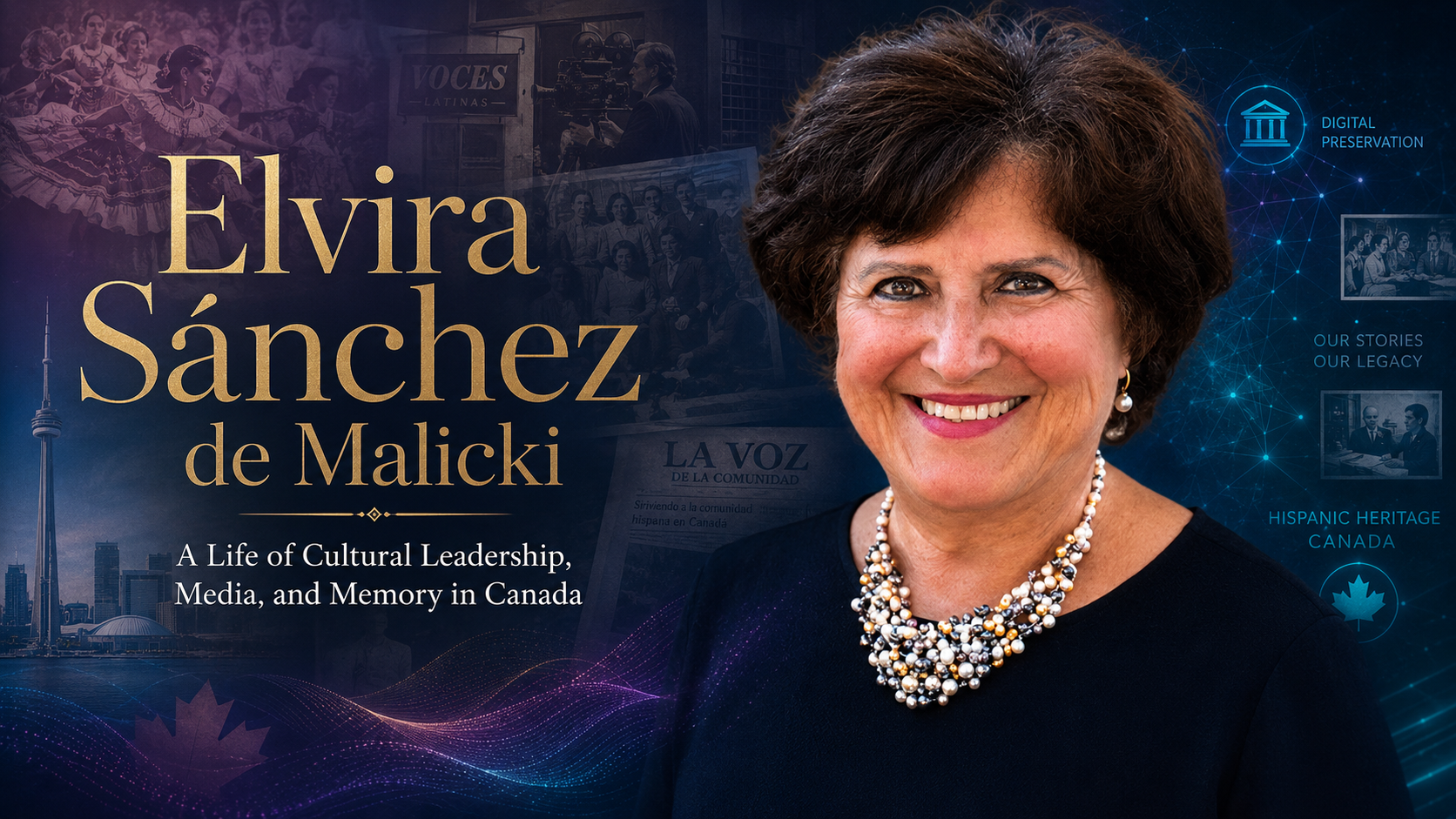
Some people spend a lifetime searching for their voice. Elvira Sánchez de Malicki learned early that a voice becomes powerful when it creates room for others.
From Guayaquil to Calgary, from theatre and television to community leadership and a virtual museum: a story of initiative, identity, and technology told in her own words.
“I do not see myself as a community leader. I see myself as a passionate woman: an idea comes to me, and I have to develop it.”
Some decisions look small when they are made, yet become a map over time. One of mine was made by a 14-year-old Ecuadorian girl who decided to travel alone to Canada to study. Another came when a young woman realized that the Hispanic community did not have enough space to tell its own stories. She founded cultural projects, organized communities, worked in media, and eventually imagined a museum without walls.
That journey did not begin with a title or a branding strategy. It began with a question: Why is our community not here? The question returned again and again—in theatre, television, public representation, archives, and finally the digital world.

I was born in Ecuador and grew up in Guayaquil, in a large, dynamic family deeply connected to the life of the country. My father was a pilot; my mother was a woman of character and vision. From an early age, I learned that circumstances are not always ours to choose, but we can choose what to do with them.
When I was about 11 or 12, I developed asthma, and my family decided to send me away to study. Later, I told my father that if I earned good grades, I wanted to study abroad. He agreed. I kept my promise and, with the help of relatives, a school, and a travel agent, I eventually travelled to Canada.
The Embassy of Ecuador in Canada documented that I arrived in Calgary in 1966 to complete one year of secondary school. What began as an educational experience became the place where I would build the rest of my public life: first as a student, then as an entrepreneur, artist, communicator, and advocate for Hispanic visibility in Canada.1
I arrived very young and practically alone. There were other Ecuadorian girls in Calgary, but over time they returned home. I turned 15 there and understood that my story could not depend on other people staying. If I wanted to continue, I had to find my own path. I moved to Ontario, studied at Notre Dame Academy, and discovered something that would stay with me: you do not need to have every answer before taking the first step.

During my final year of secondary school, candidates for the student council campaigned with balloons, signs, and promises. I was not running. Yet some younger students approached me and asked me to put my name forward.
I told them that I did not speak English fluently, had no contacts, and could not promise grand things. They insisted. I was elected school president and, from that position, pushed for changes that benefited the students. At graduation, I received the Governor General’s medal for merit in recognition of those changes.
That recognition left me with a conviction I still carry: Canada could be a place where a young immigrant without a powerful network could propose something and make it real. “Can” means ability, and I understood that it could also mean possibility: yes, we can.
At 20, I married and began working as a bookkeeper in my father-in-law’s law office. One day, my husband and I argued about the hood of a car. I insisted that it was damaged; he said it was supposed to look that way. We bet $500. I won, and I sent the money to my parents with an instruction: buy Ecuadorian products for me to bring to Canada.
That is how Sangarat South American Handicrafts began. I started importing crafts and products from Ecuador. First, I had a store in Roncesvalles; later, I moved through Yorkville; and when Square One opened, the store became one of its early retailers. I was an importer, wholesaler, and retailer before I had learned every rule of the business. I learned by doing.
My store was more than a commercial activity. It was a way to keep my origins visible. Each object carried a story, a technique, a family, and a territory. I eventually understood that culture also travels through business: it enters through a door, sits in a display window, and begins a conversation with people who may never have visited the place it came from.
In those early years, I learned another decisive lesson. A man who visited the store told me not to spend money on advertising, but to create things the media would want to cover. I called newspapers and persuaded them to visit the business. The experience confirmed something that would guide my career: a well-told story can open a door that an advertisement cannot.
In 1973, I met people working with different Latin American communities. At Caravan, I noticed that other groups had their own cultural spaces. I asked myself why we did not have a South American pavilion.
The first response was sceptical. I was told that Hispanics would never agree on a joint project. I spoke with Argentinians, Chileans, Colombians, and representatives of other countries. Doubt became conversation; conversation became coordination; and coordination became a South American pavilion that was eventually held and received an award.
I was about 23. I did not experience it as a leadership operation; I experienced it as a need. If a community has no space, someone has to start building one. That principle would return later in the Canadian Hispanic Congress, in media, and in the virtual museum.
I also wanted the Hispanic community to have theatre. I had been invited to act in English-language plays, but I kept asking why our community could not tell its own stories on stage. I founded Open Experience Theatre, a company that operated for more than a decade and presented works I wrote, adapted, or produced to reflect experiences that mattered to the community.
One of my early plays was Becoming, a bilingual theatrical ballet presented at the St. Lawrence Centre. The production received recognition for best author, director, producer, and translator. Theatre taught me that representation is not simply about being present; it is about deciding which stories are told, from what perspective, and with what dignity.
Television came next. I participated in “Nuestra Gente” and later in “Última Hora,” a Spanish-language evening newscast. The official biography of the Canadian Hispanic-Latin American Virtual Museum describes more than 20 years of television work, including presenting, news anchoring, and producing.2

Television expanded my reach, but it also exposed barriers. When I tried to enter English-language Canadian television, I was told that Canadian television did not use accents like mine. At another audition, I was told that I was not “visible enough.” Those words did not make me abandon communication; they made me insist on one idea: the screens of Canada must reflect the country’s demographic reality.
Motherhood was also part of that struggle. While travelling to organize community projects, I brought my children with me. In meetings and conferences, I argued that mothers needed spaces and support to participate. I did not want motherhood to be used as a reason to exclude women from public life.
In 1983, we incorporated the Canadian Hispanic Congress, and in 1984 we held the Constituent Assembly. I became its first president. During my term, the Congress brought together affiliated organizations and provincial chapters across different parts of the country, according to my testimony and the available institutional documentation.
The goal was broad but concrete: to facilitate Hispanic participation in the social, economic, political, and cultural life of Canada. That meant organizing conferences for youth, seniors, and women; working toward the recognition of foreign professional credentials; speaking with political representatives; and building bridges between organizations that often worked in isolation.

Today, the Canadian Hispanic Congress identifies me as its founder and a member of its advisory committee.3 For me, the Congress was not a personal platform. It was a structure that allowed the community to speak more clearly and be heard more powerfully.
I have never worked primarily for recognition. When people ask me about legacy, my answer is simple: do the work. If people later believe that the work mattered, that is beautiful, but it is not the original motivation. The reward is contributing.
In the early 2000s, I wanted to explore the possibility of creating a Spanish-language television channel. Before asking anyone for investment, I decided to prepare myself. At 55, I returned to university to complete an Executive MBA at Queen’s University. At the same time, I participated in a broadcast leadership program in the United States.
It was not easy to combine study, family, work, and professional responsibilities. At Queen’s, I had to defend the idea of using a television channel as the basis for a business plan. My team was uncertain. I insisted. I presented the project in a national competition, and it won first place.
The project did not become the channel I had originally imagined. Regulatory and economic realities made the model unviable under the conditions of the time. But studying it produced another result: it taught me to evaluate an idea rigorously without giving up the vision that created it. Sometimes an initiative does not materialize in its first form; it transforms into the next one.

Image courtesy of CHLAVM.

Elvira Sánchez de Malicki and the Work of Cultural Memory
Years ago, a representative of the National Archives of Canada told me that there was not enough material about the Hispanic community in the national record. I never forgot that conversation. If our history was not sufficiently present in archives, museums, and galleries, we needed to create a space of our own.
The answer became the Canadian Hispanic-Latin American Virtual Museum, known as CHLAVM. Its formal stage began in 2021, during the pandemic, with the support of my son Keram and a team of collaborators. The idea was not to build a museum enclosed in a building, but to create an open place: without a roof, without walls, and accessible from anywhere.
The museum began with a focused approach. Instead of trying to cover everything, we developed an experience around ceremonial and cultural expressions from Bolivia, Uruguay, and Ecuador, including the Diablada, candombe, and Inti Raymi. The work incorporated 3D capture and required technical problem-solving so that the files could be used by the public.
For Elvira Sánchez de Malicki, the platform became a laboratory of memory. It is not only about displaying objects or costumes; it is about connecting people, communities, researchers, students, and organizations. Business / Arts describes CHLAVM as a virtual organization dedicated to celebrating the achievements of Canadian Hispanic-Latin Americans and preserving and sharing their culture through a national digital model.4
The museum’s mission is cultural, but its future also depends on access: access to technology, to knowledge, and to the tools that help communities tell their own stories. Elvira Sánchez de Malicki’s work keeps that principle at the center.
Elvira Sánchez de Malicki · CHLAVM

“The only ones who can tell our story are us.”
That sentence summarizes the purpose of the museum. When others tell our story, they may do so with good intentions and still leave out essential nuances. Telling it ourselves does not mean closing the door to dialogue; it means taking part in constructing the record.
Artificial intelligence entered my work in a practical way. At first, it frustrated me: it could produce persuasive but incorrect answers, and every line had to be reviewed. Over time, I learned that the point is not to hand over control to a tool, but to use it with judgment.
To me, virtual reality and artificial intelligence serve different functions. Virtual reality allows people to experience and explore content; artificial intelligence can help research, organize, draft, create images, and simplify processes. When they complement each other, they expand what a person can imagine and execute.
My position is clear: technology does not replace human responsibility. It can optimize work, but a person must read, review, correct, and decide. This matters especially for communities that have historically had fewer resources. If artificial intelligence lowers technical barriers, more people can create, document, and participate.

I do not want the Hispanic community to arrive late to this transformation. We have talent, ideas, and experience. What we need is access, confidence, and places where people can learn without feeling intimidated.
I want the museum to be recognized as a space belonging to the community and eventually to serve as a directory of Hispanic and Latin American organizations in Canada. Many people are looking for an association, cultural project, educational initiative, or support network. A living directory could connect those pieces.
We also need partnerships with academic institutions, students, volunteers, cultural organizations, businesses, and people who want to contribute. The museum has moved forward through volunteer work and the collaboration of people who believe in preserving memory. The next step is to broaden that network so the project can grow sustainably.
My dream includes a major artificial intelligence event in which the Hispanic community is not an audience but a participant. I do not want to repeat formulas simply because everyone else is following them. From a young age, I learned that sometimes it is better to move in another direction. Perhaps that is where we will find new possibilities.
I have lived many lives within one: that of an Ecuadorian girl who arrived in Canada, an entrepreneur who imported crafts, an actress and producer, a television presenter, a community organizer, an adult student, and a woman who decided to build a virtual museum when it seemed there was no place for our memory.
I did not do everything perfectly. I also did not wait until I felt completely ready. Many times, I moved forward while learning. That has been my way of working: with passion, vision, and enthusiasm.
We live one life. We can choose to do what gives us personal satisfaction, or we can try to plant something that others will harvest later. I prefer to plant.
So my message to women, immigrants, and anyone with an idea is the same one that has accompanied me since I crossed the map as a teenager: take the leap. Do it with passion. Find allies. Learn what you do not know. Protect your community’s history. And do not wait for permission to begin.
Elvira’s journey continues through the Canadian Hispanic-Latin American Virtual Museum, the Canadian Hispanic Congress, and new conversations about artificial intelligence and access.